• Skip to main content
  • Skip to primary sidebar

Death Matters

Planning Together for End of Life

  • Home
  • About
    • About Us
    • Media & Press
    • Testimonials
  • Programs / Events
    • Departure Directions
    • Exit Planning
      • Purchase Exit Planning Workbook
    • Death Cafe
    • Green Burial Cafe
    • TIBETAN BOOK of the DEAD ~ Annual reading
    • How Not to Die
    • Unfinished Business
  • Calendar
  • Services
    • Spiritual Care Planning
    • Circles of Care
    • Green Burial
      • How to Guide for Natural Cemetery in Nova Scotia
    • Advance Planning
    • Presentations and Conversations
    • Caring for the Body after Death
    • Funeral Guidance
    • Death Doulas
  • Resources
    • End of Life Services in Nova Scotia
    • Grief Support in Nova Scotia
    • Books
    • Websites
  • The “D” Word
  • Contact

DONATION – Organ and Tissue

April 3, 2019 By Dawn Carson


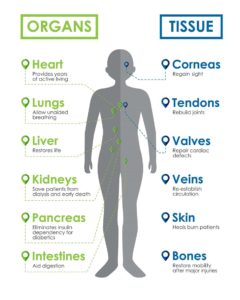
On January 18, 2021, Nova Scotia became the first jurisdiction in North America to adopt a “deemed consent” model for organ and tissue donation. Under the Nova Scotia Human Organ and Tissue Donation Act, all eligible residents are presumed to have consented to donation after death unless they opt out.

If you’re 19 or older, have lived in Nova Scotia for at least 12 months, and haven’t opted out, you are considered a potential donor. This change was made to help increase the number of lives saved through organ and tissue transplants.

You can opt out at any time by registering your decision online with your Nova Scotia Health Card. Youth aged 16 or older can also register a decision, though individuals under 18 or those lacking capacity will require consent from a substitute decision-maker.

Even with deemed consent in place, families will still be consulted at the time of death. Medical teams will seek to understand any known wishes of the deceased before proceeding with donation. In addition, all medically eligible individuals will be referred to the appropriate provincial donation programs to assess suitability.

What happens after death?

If death is expected, the body becomes part of the deceased’s estate, and the executor or family is responsible for final arrangements. If death is unexpected, the medical examiner has temporary jurisdiction over the body for investigation before releasing it to the family or executor.

For those who wish to provide home deathcare, participate in spiritual or cultural rituals, or arrange a green burial, there are important considerations:

  • Who will have authority over the body after donation procedures?

  • What condition will the body be in following organ or tissue recovery?

  • Will medical teams avoid toxic chemicals and ensure respectful suturing and preparation to allow for home vigil or green burial?

These are essential questions, especially for families wanting a more personal or environmentally conscious approach to deathcare. Open communication with medical staff is vital to ensure the body is handled in accordance with your values and wishes.

For more information or to register your donation decision, visit:
Nova Scotia Health: Organ and Tissue Donation

Filed Under: The "D" Word

DENIAL

March 19, 2019 By Dawn Carson

Spoiler Alert – you will die.

In 1973 Ernest Becker won the Pulitzer Prize for The Denial of Death.  We’ve been denying for a while.  The toss-up seems to be with the dual nature of our physical selves and our symbolic selves. And that comes down too,  here we are… what does it mean?  The search for meaning or the true nature of reality is good/absolute.  It awakens the mind and that, my friends, is a connection to the present, which is wisdom. 

They say our life flashes before our mind’s eye in our final days.   Will yours be all scared and in denial about the fact that you will die?  Or might we find meaning which has us present in our everyday lives?… with whatever is?

Why exactly are we so frightened of death that we avoid looking at it altogether? Or worse, we take all manner of measures to get more “dying days”. 

Somewhere, deep down, we know we cannot avoid facing dying and death forever. Nothing is permanent and enduring.

When you are in denial, you’re trying to protect yourself by refusing to accept the truth about mortality.

When you are in denial, you’re trying to protect yourself by refusing to accept the truth about your dying and death that is  happening. Refusing to acknowledge mortality is a way of coping with fear, stress, painful thoughts, conflict, threatening information and anxiety. You can be in denial about anything that makes you feel vulnerable or threatens your sense of control, such as dying.  You can be in denial about something happening to you or to someone else.

When you’re in denial, you:

~ Will not acknowledge a difficult situation

~ Try not to face the facts

~ Downplay possible consequences of the matter.

Sometimes it seems as if the only real activity we are engaged in is closing our eyes to the truest fact about life: No one makes it out alive.

Filed Under: The "D" Word

DETAILS

February 8, 2019 By Deborah Luscomb

The devil is in the details.

Preparing advance directives may seem like an easy task at first.  But why does it continually move to the bottom of the pile on the desk?  What could be so very challenging that we are unable to put our wishes in writing with ease?  There are just a few seemingly simple decisions to make, after all.

However, the decisions in question require that we confront our mortality…. often a more than daunting task.  So how can we do it?  How can we contemplate the unknown details we might face as we approach the end of our life?

In addition to contemplation, conversation with friends and loved ones might be a useful activity to instigate decision-making.  Simply imagining – out loud – how it might feel to be at the end of your life could be a great beginning.  What does it look like?  Who is around you? Smells?  Sounds?  Fear?  Anxiety?  Discord?  Anticipation? 

We cannot possibly know how our end will come – or go.  However, we can begin to ‘plan’, based on our own held values and preferences, the kind of container and care that might suit us best.  And document and share that information with our loved ones.  These are the kinds of details that create advance directives.

Filed Under: The "D" Word

DISCUSSION

December 10, 2018 By Deborah Luscomb

Dead is a four letter word.  Perhaps that is why it is not uttered in polite company.  There is very little general discussion about what happens when dying, after death.  It seems to be some kind of secret.  But we all do it.  Like sex. Let’s talk about it.  Might make it easier.

Imagine if dying & death were common subjects of discussion… if we could approach this very normal life experience (which we share with each and every sentient being on the planet) as ordinary…. as healthy… as universal… perhaps even celebratory.  Discussion over dinner, at the spa, while walking in the park, or driving the kids to school…

We might even have ordinary, everyday discussions about our preferences at the time of dying …. who would be there, details of the environment – sounds, smells, sights.  Not that we really have a choice.  But imagine what it might be like if close friends and family actually knew what we wanted, actually understood our values and wishes… without fear.  Imagine…. the possible benefits of discussion of our hopes and fears.  Death matters.  Discussions of death matter.

Filed Under: The "D" Word

DISPOSAL

November 15, 2018 By Deborah Luscomb

The word ‘disposal’ is a roundabout way of getting to the word ‘corpse’.  It happens to be something that is necessary to do with a corpse… one way or another.  What way will you choose?  Or will you let someone else make that decision (another great ‘d’ word) for you?  If so, who?  How will they know what you want?

What are the choices for disposal of a corpse here in Nova Scotia?

None of the above….. yet.

However, you do have the options of cremation, conventional burial, or green burial.  The former two have a significant negative impact on the environment.  The latter, however, replenishes our soils, and leaves a very minimal carbon footprint.

So, if you care about the method of disposal of your corpse, you might want to consider your options before you die, and document and share them with the folks who will be taking care of your body.

If you care about the environment, choose green burial…. for more information go to www.greenburialns.ca.

Filed Under: The "D" Word

  • « Go to Previous Page
  • Page 1
  • Page 2
  • Page 3
  • Page 4
  • Page 5
  • Go to Next Page »

Follow Us on Social Media

Follow us on Facebook and Twitter
 

Join Our Email List

Purchase Exit Planning Workbook

Been putting off your end-of-life paperwork?  Finding it difficult to know where to begin?  The EXIT PLANNING Workbook provides a path to completion.  Download it now.  And get on with your life!

PDF with fillable fields, 56 pages. $24.00.

Click here to purchase.

The “D” Word

DO

DO: Make Your Plan When it comes to end-of-life planning, one simple word can make all the difference: Do. Many people mean to get their affairs in order. They talk about it, think about it, and plan to “get to it someday.” But the most important ...

Read More →

Upcoming Events

Quotations

Loading Quotes...

Contact Death Matters   •   Email: deathmattersns@gmail.com   •   Phone: 902.403.7590